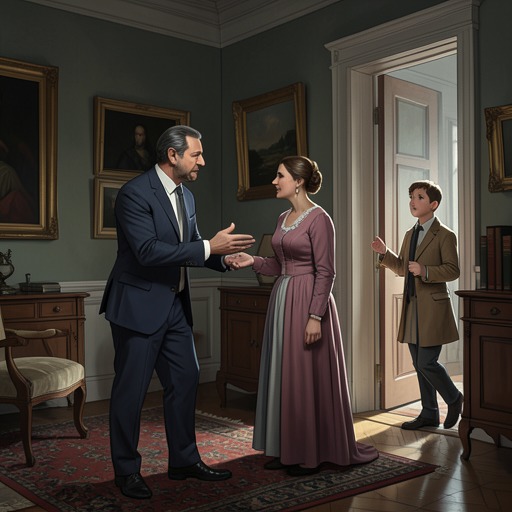
Apostolos Papazoglou and Manos Papazoglou
Cartes Postales from GreeceApostolos Papazoglou and Manos Papazoglou are bound together by a succession contest that Apostolos devises to keep his hotel group intact, but the test ends by destroying the inheritance it was meant to allocate. As Apostolos’s seventy-fifth birthday approaches, he wants to retire without dividing the business or simply handing it to Manos, the elder son whose succession everyone expects. In private, he considers Stephanos more charming and better suited to the role. The contest is therefore not a routine transfer of authority: it makes the sons’ performance, rather than birth order, the formal basis for choosing their father’s heir.
Family Background and the Succession Problem
Manos and Stephanos have grown up in the comfort of their father’s expanding hotel business. For ten years, they spent summers at its luxury resorts, relying on room service and Coca-Cola; neither had ever made a bed. They had no memory of the crowded early period when the family slept head to toe on a divan in a one-bedroom apartment in Patras. By the time they were in their twenties, the brothers bickered constantly, while their mother had encouraged them to feel exceptional and their father had been too occupied with making money to notice how little practical experience they had acquired.
Their upbringing helps explain the difficulty of Apostolos’s decision. The sons have each assumed that half the business will eventually pass to them, but neither has prepared through further study or learned the ordinary work of running a hotel. Apostolos’s plan rejects the expected division of the empire and turns an unsettled family expectation into a competition with a single winner. His preference for Stephanos’s charm complicates the appearance of a neutral test: although he lets results decide, he has already privately judged the brothers’ different qualities.
The Test and Manos’s Assignment
Melina Papazoglou proposes that her husband set the brothers a test and determine who performs better. Apostolos accepts. At the family celebration for his seventy-fifth birthday on 13 October, he produces an old drachma coin and announces the terms over a chocolate gateau. He has two undeveloped sites in Patras, one near the busy port and the other on a stretch of sand outside town. The coin will assign the plots; after two years, the son whose balance sheet is ahead—even by ten drachmas—will take over the entire hotel empire.
The coin gives Manos the port-side site and Stephanos the beach plot. It settles only who gets which opportunity, not who will inherit: that decision remains attached to the hotels’ financial results. The timing also draws a warning from the restaurant staff. They regard the thirteenth as unlucky, especially in Greece, and connect the digits of 1453 with the number. Their muttered disapproval places the contest under an omen before either son has begun building. The brothers, shocked by the all-or-nothing terms, now have to compete for a prize they had expected to share.
Manos approaches his site with a different business model from Stephanos’s seasonal beach trade. He does not want to depend chiefly on tourists; he aims to attract businesspeople, commercial travellers, and dock workers, customers who might spend money throughout the year. An empty, box-like office block already stands on the port property. Demolishing it would be costly, so Manos chooses to convert it. With a ruler and set square, he sketches a square, turreted hotel inspired by the old castle at Nafplio. The design gives the former office building a fortress-like exterior, while inside the spaces are divided into smaller rooms and bathrooms are installed. The hotel, named Hotel Pyrgos, is intended to embody a confident commercial vision; its costly promise of permanence will later contrast with its deteriorating rooms and precarious finances.
Manos’s Hotel and the Unravelling Contest
The first summer appears to validate both sons. Apostolos is impressed by their profit margins and, to their relief, does not inspect the businesses more closely. But Manos conceals the reality behind Hotel Pyrgos, even from himself. A few months after its opening, Giorgos Kourtis, an occasional customer who has used the private gambling room, reveals himself as more than a guest. He owns a rival hotel in the centre of town, has powerful connections, and sees his business losing customers to Manos’s new establishment.
The pressure becomes direct. About five months after opening, the electricity is cut off. Manos initially makes the outage seem romantic by arranging candles, but electricians find no fault in the system: the hotel has been disconnected, and restoring service requires five million drachmas. The water is cut off in the same way, with the same demanded fee. Manos comes to understand these charges as extortion. The disruption is followed by destructive police searches for gambling, which the officers find because they know where to look. Their recurring visits make a bribe seem necessary if the hotel is to survive. Manos believes Kourtis is directing the pressure, while the informal power behind the rival’s business steadily consumes the money that Manos needs to compete.
The hotel’s physical design also fails to protect its finances. Random power cuts leave winter rooms without heat; cold winds from the Ionian Sea drive indoor temperatures below ten degrees, condensation forms on the walls, and the painted muses begin to flake. Occupancy drops in the colder months, and the building deteriorates as another summer season approaches. Manos borrows repeatedly to meet the extortion demands and pay bribes, knowing that the balance sheet for his father is due in October. His debt leaves him unable to sleep and triggers regular asthma attacks. He gains enough weight that climbing to his second-floor office becomes difficult, while he cannot afford to repair the lift. His girlfriend leaves after six months, having found the cost of his unraveling life too high. Meanwhile, Stephanos’s Thalassa is flourishing: it can earn a profit while open for only half the year, with beach-bar drinks and expensive water-skiing bringing in revenue.
Collapse and the Failed Inheritance
The contrast between the brothers’ ventures becomes stark after an earthquake destroys the Thalassa. Stephanos’s hotel collapses in minutes, killing thirty of the more than two hundred guests staying there and injuring about a hundred others. Investigators find that the building was constructed without regard for guest safety, and bereaved families and injured survivors take Stephanos to court for negligence. Hotel Pyrgos suffers only one cracked window, but Manos’s building remains standing just as his business fails. Its structural survival cannot rescue him from debts whose compounded interest exceeds what he could repay even if the hotel were full.
On the same day Stephanos is charged, Hotel Pyrgos loses its final guest and its last employee, who has gone unpaid for six months. Manos drinks from the remaining bottle of Johnnie Walker and moves through the empty hotel. When a police officer arrives, Manos recognizes the watch on his wrist as the one Apostolos gave him for his twenty-fifth birthday. Orestes Sakaridis had accepted the watch in lieu of money during an earlier visit, when Manos had already run out of funds. The object makes the financial collapse visible as a personal and familial one: a birthday gift from the father has passed into the hands of the officer repeatedly connected with the hotel’s troubles. Manos, with nothing left to pay, opens the door; shortly afterward, police pursuing him hear over the radio that their colleague’s body has been found on the steps of Hotel Pyrgos.
Apostolos’s seventy-seventh birthday was supposed to mark his retirement and the transfer of his empire to one son. Instead, both sons face trial, with proceedings due to begin in Athens on the same day. Melina suggests that he toss a coin to decide which trial to attend, echoing the coin toss that had allocated the hotels. The repetition offers no resolution: the first toss divided the opportunities, while the later one can only force Apostolos to choose where to be present as his sons confront the consequences.
Seven months later, on 29 May—the date on which the rival hotels had opened—the verdicts in both cases are manslaughter. Compensation owed to injured guests and bereaved families exceeds what the sale of the entire hotel empire can cover, and Apostolos is forced to declare bankruptcy. His test never produces the successor it was designed to identify. Instead, the competition exposes how little the sons’ privileged upbringing prepared them for responsibility, while the legal and financial consequences of their hotel ventures consume the inheritance altogether. The ruined hotels stand for years like ghostly remnants, and people in Patras remember both the opening date and the warnings about its unlucky association. What began as a father’s attempt to choose between his sons ends as the loss of the business, the sons’ trials, and a public reminder that the family’s fortune could not shield it from the consequences of its choices.